Case study · Live · 2025–2026
Polymarket Trading Agent
An autonomous multi-agent prediction market trading system. Claude as a research brain, 4 independent probability estimators, and a 139-member weather ensemble to identify and trade mispriced bets on Polymarket.
13
Active agents
139
Ensemble members
11
Pre-trade risk checks
92
Open positions

01
The concept
Prediction markets price real-world events as tradeable contracts. When the market price diverges from the true probability, there's an edge to exploit. This bot autonomously identifies these mispricings, researches the underlying events, estimates true probabilities, and executes trades — all without human intervention.
02
13-agent orchestration
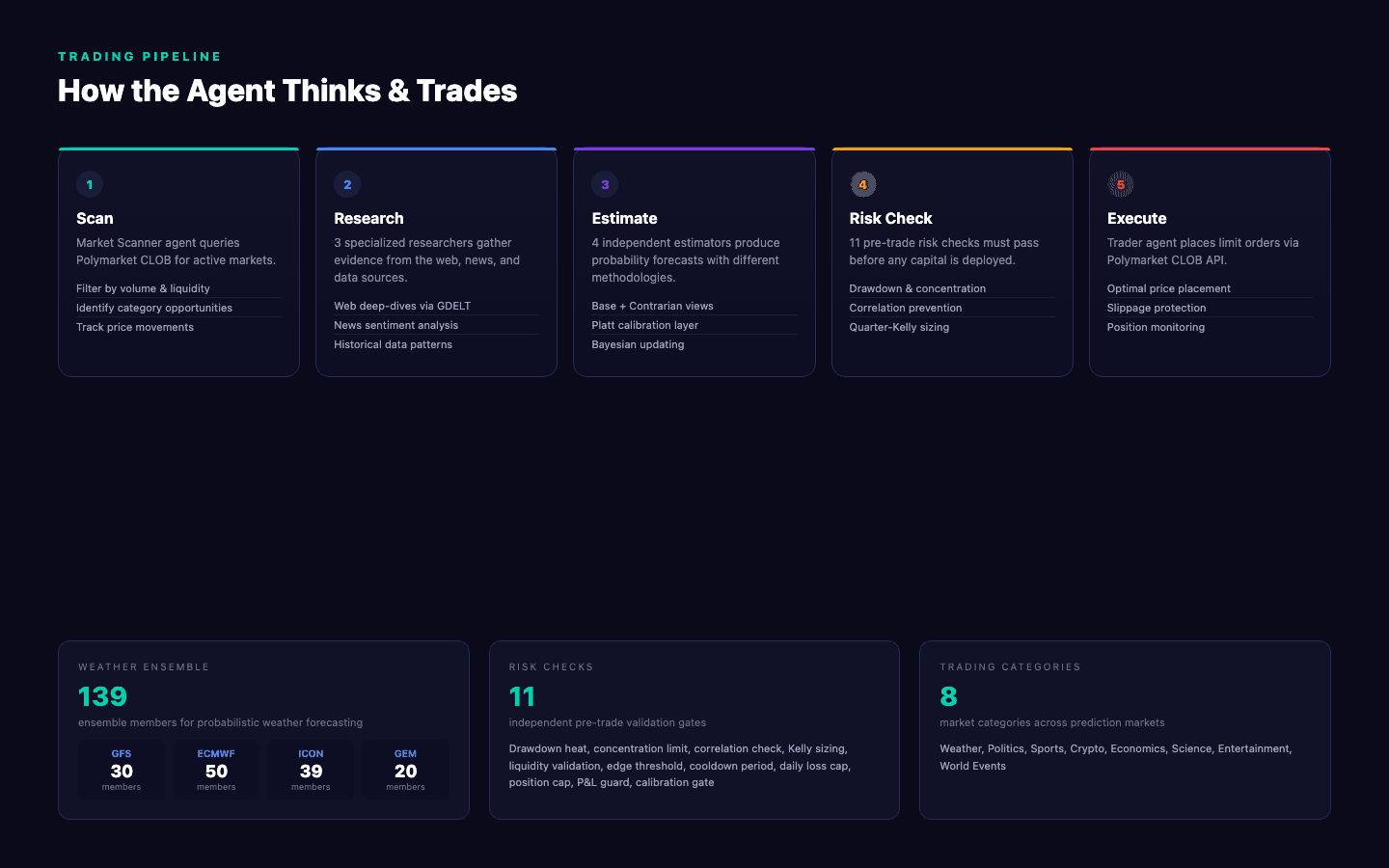
The system orchestrates 13 specialized agents — market scanner, 3 researchers (web, news, data), 4 independent estimators (base, contrarian, calibration, Bayesian), an aggregator, risk manager, trader, orchestrator, and portfolio monitor. Each agent has a focused responsibility and communicates through structured interfaces. Every trade flows through a 5-stage pipeline ending in execution via the Polymarket CLOB API with slippage protection.
03
Evolution: V1 to V4
The system evolved through 4 major versions. V1 used a single LLM estimator and lost money. V2 introduced multi-estimator consensus. V3 added Platt calibration to fix systematic overconfidence. V4 pivoted to weather ensemble trading — using 139 numerical weather model members instead of LLM estimation for weather markets, dramatically improving accuracy on the highest-volume market category.
04
Weather ensemble
The weather trading module queries 139 ensemble members across 4 major forecast systems: GFS (30 members), ECMWF (50 members), ICON (39 members), and GEM (20 members). By counting what fraction of ensemble members predict a given outcome, the system generates calibrated probability estimates for temperature, precipitation, and extreme weather markets — without relying on LLM estimation at all.
05
Risk management
Every trade must pass 11 independent risk checks before execution — maximum drawdown limits, concentration caps, correlation prevention, daily loss limits, cooldown periods after losses, and position count caps. The quarter-Kelly criterion keeps position sizes conservative, betting only 25% of the theoretically optimal amount.
Stack